
The Death of Dialogue is the Death of The Logos
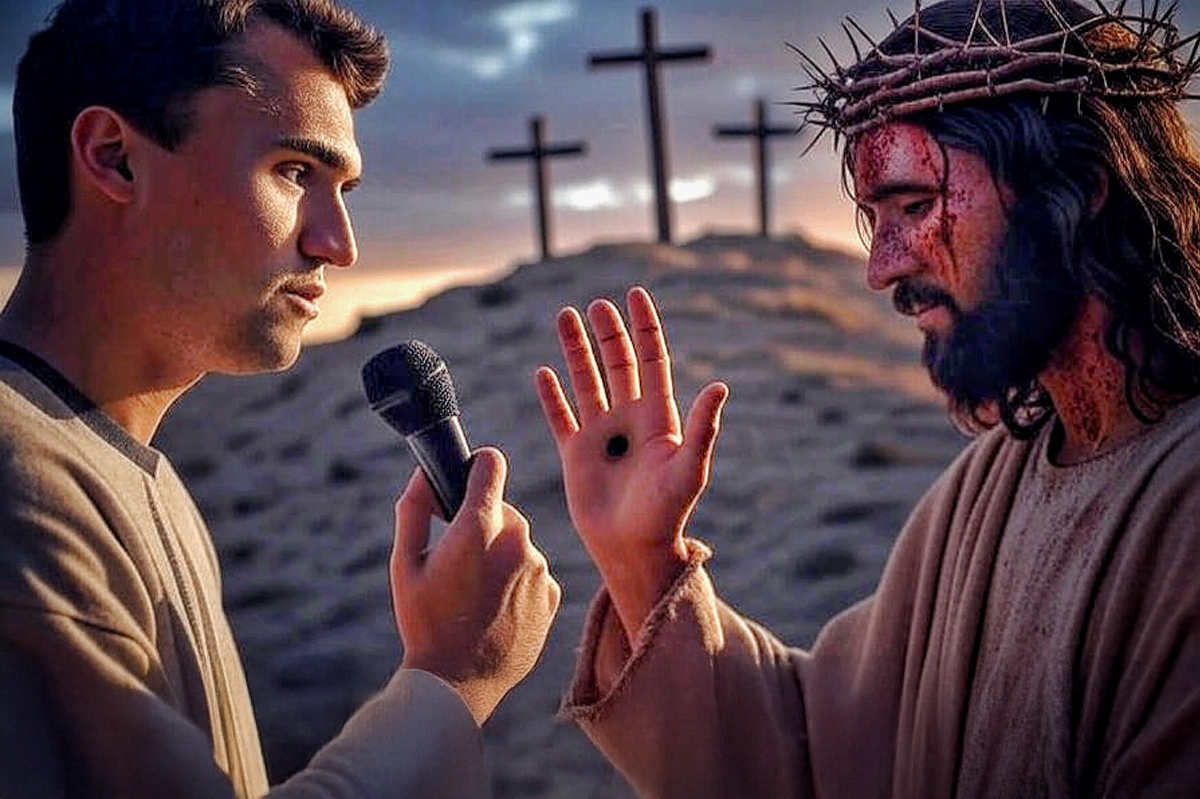
How Charlie Kirk’s Murder Echoes Eternity
Three weeks ago, our nation reached a turning point after a man who dedicated his life to free speech was heartlessly assassinated on a college campus. Charlie Kirk, a young political mogul and avid Christian, gave his life defending one of the most sacred rights of mankind. The proud husband and father of two was mercilessly killed in front of the eyes of thousands for daring to have an opinion and challenge others to a friendly debate. Charlie Kirk defended more than just the right to say what you please, however, and was an advocate of something even more vital to the human soul. Dialogue.
Dialogue is, arguably, one of the most fundamental rights of any human society, as a principal force which binds men to each other. As the country draws further from its Christian roots, the thread that bound us together has been severed, and the right to dialogue has come into the culture’s crosshairs. In the wake of Charlie Kirk’s death, we must now ask ourselves, what is dialogue and why did it come under attack in so vicious a way? Many Christians have rightly been shocked to the core and confused why evil struck such an innocent man.
The topic of dialogue has weighed heavy on my heart in recent months as something to explore more deeply, and the assassination of Charlie Kirk has made it more imperative to defend. Though an exhaustive analysis will not be made possible in this essay, I hope to investigate its roots and the place it has in the lives of the faithful. We will begin by looking more closely at the etymology of the word dialogue and how it relates to the Christian faith, since Pope Leo XIII exhorts us that “Nothing is more useful than to look upon the world as it really is.”[1]
WHAT IS DIALOGUE
Dialogue comes from the Greek διάλογος, or dialogos (dia – through, logos – the Word, logic, reason). If Scripture identifies the Son as the Logos (John 1:1), the eternal speech of the Father, then dialogue can accordingly be interpreted as ‘through the Word’. To dialogue, therefore, is to enter into the speech of the Father and hence, the life of the Son, Jesus Christ.
Pope Benedict XVI expands on this in his 1968 work, Introduction to Christianity. “God is One but there exists in him the phenomenon of dialogue, of differentiation, and of relationship through speech… In the one and indivisible God there exists the phenomenon of dialogue, the reciprocal exchange of word and love. This again signifies that the ‘Three Persons’ who exist in God are the reality of word and love and their attachment to each other.”[2]
Benedict similarly affirms this point in 1986, writing, “The one, transcendent God of the Old Testament unveils his innermost life and shows that, in himself, he is a dialogue of eternal love. Since he himself is a relationship – Word and Love – he can speak, feel, answer, love. Since he is relationship, he can open himself and provide his creature with a relationship to him.”[3]
How, then, do God’s creatures enter into dialogue with him? Once more, Benedict XVI has an answer for us. “The Christian dialogue with God is mediated by other human beings in a history where God speaks with men… It takes place, therefore, within the ‘body of Christ,’ in that communion with the Son which makes it possible for us to call God ‘Father’. One can take part in this dialogue only by becoming a son with the Son, and this must mean in turn by becoming one with all those others who seek the Father. Only in that reconciliation whose name is Christ is the tongue of man loosened and the dialogue which is our life’s true spring initiated.”[4]
This insight from Benedict indicates both vertical and horizontal dimensions to our query. To dialogue, one must open themselves up to God and man. These foundations are achieved perfectly in the person of Jesus Christ, who took on these very two natures to establish a permanent union between the human and divine. The Greek translation of dialogos, ‘through the Word’, makes all the more sense, then, to describe its fundamental nature.
The modern mind would have you believe that dialogue is just another word for conversation. Merriam-Webster’s Dictionary literally defines ‘dialogue’ as “a conversation between two or more persons.”[5] This definition is far from fitting enough and completely discards the richness behind its etymology. Beyond mere discourse, to enter into dialogue means to enter into the life of the Son. Dialogue is not a conversation, but a relationship where the vertical meets the horizontal. It is itself a participation in the life of the Trinity where Three Persons share in deep, intimate, self-giving love.
Love so concrete is harder to identify on Earth, just as the Word-made-flesh went almost unnoticed on a cold December night when Herod missed the Christ-child lying in a manger surrounded by shepherds. The Church and Her Sacraments are to us the more obvious forms of this love, and the Eucharist is the root which draws all creation into Christ and animates us into being. But just as the consecrated host appears to the naked eye as simply a piece of bread, the Eucharistic mystery between the Father and the Son, still veiled in the world, may be just as hard to discern in its divine essence.
RULES FOR DIALOGUE
Can two people gathering to discuss a range of current events, as Charlie Kirk was known best for, meet the criteria for a divine encounter? Discourse in itself can’t always be considered divine, nor does merely centering a conversation around weighty topics. So how can we better identify when the meeting of two minds does accomplish this? Thankfully, the late Pope Francis gave us some boundaries and aptly laid out exactly what dialogue is not. In his 2020 encyclical Fratelli Tuti, Francis wrote to the faithful, “Dialogue is often confused with something quite different: the feverish exchange of opinions on social networks, frequently based on media information that is not always reliable. These exchanges are merely parallel monologues. They may attract some attention by their sharp and aggressive tone. But monologues engage no one, and their content is frequently self-serving and contradictory.”[6]
The etymology of monologue and its antithetic meaning to dialogue will help us better understand the two. As ‘dialogue’ comes from the Greek dialogos, monologue is derived from monologos, which means “speaking alone or to oneself”. While dialogue infers unity and otherness, monologue, in contrast, is aloneness. It is when one has nothing to communicate to others. As any man can attest, it is wholly possible to have conversations that are full of words but utterly empty of meaning.
Bishop Robert Barron places similar boundaries on dialogue, writing in The Priority of Christ, “As we have seen, humility, openness to the other, a willingness to be corrected, and inclusion of challenging perspectives are all necessary for dialogue, but conversation devolves into shrill chattering unless certain restrictions are in place.”[7] Boundaries on dialogue are essential not so certain things might be precluded, but rather, to protect its integrity, elevate her beauty, and make authentic dialogue easier to discern.
Echoing the same sentiments earlier established, Bishop Barron likewise connects dialogue to the first verse of John’s Gospel. “It should not be surprising that the fullness of knowing would occur through an intersubjective process, with knowers, as it were, participating in one another as each participates in the thing to be known. If, as the Johannine prologue implies, the ground of being is a conversation between two divine speakers, it seems only reasonable that the search for intelligibility here below takes place in the context of a steady and loving conversation.”[8]
This last line from Barron is the jackpot. The conversation must be steady and loving, and it must pattern man’s desire for knowing. Charlie Kirk’s American Comeback Tour met these criteria very well and was one of the less immediately recognizable proofs of the Father’s activity in the world. It was, I believe, one of God’s many clandestine ways of traversing undetected through the culture precisely by entering right into it.
THE COMMUNAL LIFE OF THE TRINITY
With a breath of excitement, Saint John XXIII noted in his 1963 encyclical Pacem In Terris, “Men today are taking an ever more active part in the public life of their own nations, and in doing so they are showing an increased interest in the affairs of all peoples. They are becoming more and more conscious of being living members of the universal family of mankind.” The Pope who famously convened the Second Vatican Council continued, “We exhort Our sons to take an active part in public life, and to work together for the benefit of the whole human race, as well as for their own political communities.”[9]
Since Heaven is a community, political engagement to John XXIII mirrors the communal life of the Trinity, which is why he urged Christians around the globe to promote the welfare of their communities. Prior to the ecclesial communion of the saints is the eternal community of Father, Son, and Spirit, which all earthly communities formed in love advance us towards.
Decades later, John XXIII’s call to action was answered by Kirk. In the age of social media mobs where the loudest voice wins, Charlie’s prove-me-wrong debate series provided politically-minded youths an opportunity to encounter truth in a well-organized, respectful, and orderly format. Contrary to the side-by-side monologues Pope Francis warns us about, the format of the debates hosted by Turning Point USA attempt to eliminate this by respecting the integrity of debate and preserving a fair environment for each party to be heard. A microcosm of the loving and steady conversation between the Father and the Son, the two microphones juxtaposed before Charlie and his challengers represent the ever-present ache of our generation to encounter truth.
The seeking out of truth in others is exactly what the Christian faith is. In his first encyclical, Deus Caritas Est, Pope Benedict XVI writes that Christianity is not a lofty set of ideas, but “the encounter with an event, a person [Christ], which gives life a new horizon and a decisive direction.”[10] Our hearts are wired to know that truth is not abstract, but deeply personal. So personal, in fact, that Truth has a face, a pulse, a voice, and a touch. And, as we earlier noted, Benedict mentions that our encounter with God is mediated by other human beings.
This knowledge takes our appreciation for Charlie’s debate tour to a new level when we consider what Benedict XVI later observes in Deus Caritas Est. “Only my readiness to encounter my neighbour and to show him love makes me sensitive to God as well. Only if I serve my neighbour can my eyes be opened to what God does for me and how much he loves me.”[11] These two microphones and their mediated environment created a space for young men and women to encounter truth in the differences of another and open them to God.
Bishop Barron similarly recognizes this environment as the mode proper to the human person’s ability to encounter truth. He writes, “The proper setting for the Christ-mind is a community of dialogue, an intersubjective conversation, since the God who grounds intelligibility is himself a conversation of coinhering persons.”[12] The beginning of this sentence is extremely revealing. In sync with our earlier definition of dialogue (through the Word), Barron hints that dialogue allows us to enter into the very mind of Christ. Beyond simple activation of our rational faculties, dialogue activates the Holy Spirit and summons him into our relationships. By creating a community of dialogue, Charlie Kirk in turn created a proper setting for the Christ-mind, a noteworthy accomplishment worth praising. Though the two parties invited to conversate share different perspectives, the sheer act of dialogue has invited them into an intimate union with the Trinity.
THE TRANSCENDENT THIRD
Important to our considerations here is the truth that even within the Trinity, there exists both difference and distinction between the Father, the Son, and the Holy Spirit. So right off the bat, the bringing together of people who have radically different worldviews is itself a share in the life of God. At the end of his public ministry, Our Lord tells his disciples, “Where two or three are gathered in my name, there am I in the midst of them” (Matthew 18:20) to assure them of his continued presence after he dies on the Cross. It is fitting to consider the possibility that even without necessarily knowing it, both parties present to a debate are gathered in his name by virtue of dialogue being his name (logos), as well as the transcendent-third they both mutually adore.
Indeed, without even realizing, a socialist and a capitalist, a Democrat and a Republican, or even a pro-choicer and pro-lifer who enter into dialogue become active participants in God’s flow of grace. Both participants in any given dialogue stare lovingly at Truth (a name Christ identifies himself with), or at the very least, their perception of it. Justice, charity, and kindness are among the other names Our Lord goes by which we admire together in dialogue.
It is important to stress the notion of the transcendent-third when it comes to political discussions such as the ones Kirk fostered, since some ideas shared in these debates fly in the face of reason and can hardly be considered Christian. And yet, in all his goodness, behind the sharing of these illogical ideas can still be an unrealized love of God. We know from Scripture that Moses could only see God’s back. Zacchaeus saw Christ from a tree. The hemorrhaging woman saw his garments. The adulteress looked up at Our Lord from the ground. And Bartimaeus couldn’t see him at all. And yet, despite having vastly different points-of-view, all loved Our Lord, and to the blind he even gave sight. Thus, when two parties gather to debate their notions of a just society, true Justice has entered more deeply into the world, since they together gaze lovingly towards a divine other outside themselves.
OPENNESS TO THE OTHER
Modern dialogue might make such observations harder to spot, but even conversations with heightened emotions and elevated voices can still be deeply Christological. At its core, dialogue represents an openness to reason (logos) and, more strikingly, to the other. The courage of a woke, college liberal to stand before hundreds of jeering conservative students stands athwart the shame of our first parents, Adam and Eve, who covered up and hid after the fall. The will to stand before a crowd vulnerable and exposed allows participants to share deeply in Our Lord’s passion, and his redemption of man. Even when Charlie could not successfully convince his opponents of Biblical truths, their conviction to stand before the judgment of men naked and fearless is evidence that Truth has already begun to soften their hearts.
This is why Charlie defended free speech to the death. And this is why we must protect dialogue at all costs. Present in our words is the Word himself, waiting to burst through any door that is even slightly open to him. On a deeper level then, openness to dialogue is openness to Christ. To faithfully fulfil our duty to proclaim the Gospel to all nations, we must work tirelessly to resist anyone who opposes free speech and seeks to limit dialogue in the public square. If dialogue is the Word of the Father, then all restrictions on the dialogos are crucifixions of the Son.
This is why Charlie was killed. True evil will never enter into dialogue, since it is incapable of doing so. “This is the Spirit of truth, whom the world cannot receive, because it neither sees him nor knows him” (John 14:17). The death of dialogue is the death of the Logos. It is evil’s attempt to once more crucify the Son of God. But in Our Lord’s divine providence, the man who died defending this right has now, we pray, entered fully into the eternal dialogue of the Father and the Son, and drawn even the hatred of his killer into the purifying light of Christ.
A scene from the Passion, as told by Bishop Barron, can fittingly connect us to the death of Charlie Kirk. “As he approached his death, Jesus was stripped of everything that might protect, bolster, or puff up the ego: reputation, comfort, esteem, food, drink, even the pathetic clothes on his back. And since he is nailed to the cross, he cannot grasp at anything at all. What he remains attached to is nothing but the will of his Father.”[13] At the hour of his death, Charlie remained attached to his microphone. In the palm of his hand was the symbol of speech. Charlie used his to pattern the Word of the Father and give him a voice in the twenty-first century. Let us be as courageous as him to defend dialogue. It is a right worth dying for.
“Jesus defeated death so you could live.” – Charlie Kirk[14]
Bibliography
[1] Leo XIII, Rerum Novarum (Encyclical Letter, Vatican City: Libreria Editrice Vaticana, 1891), no. 18.
[2] Joseph Ratzinger, Introduction to Christianity (San Francisco: Ignatius Press, 2004), 182–183.
[3] Joseph Ratzinger, Behold the Pierced One (San Francisco: Ignatius Press, 1986), 86–87.
[4] Joseph Ratzinger, Eschatology: Death and Eternal Life (Washington, D.C.: CUA Press, 1988), 159.
[5] https://www.merriam-webster.com/dictionary/dialogue
[6] Francis, Fratelli Tutti (Encyclical Letter, Vatican City: Libreria Editrice Vaticana, 2020), no. 200.
[7] Robert Barron, The Priority of Christ: Toward a Postliberal Catholicism (Grand Rapids, MI: Brazos Press, 2007), 163.
[8] Ibid., 161.
[9] John XXIII, Pacem in Terris (Encyclical Letter, Vatican City: Libreria Editrice Vaticana, 1963), nos. 145–146.
[10] Benedict XVI, Deus Caritas Est (Encyclical Letter, Vatican City: Libreria Editrice Vaticana, 2005), no. 1.
[11] Ibid., no. 18.
[12] Robert Barron, The Priority of Christ: Toward a Postliberal Catholicism (Grand Rapids, MI: Brazos Press, 2007), 186.
[13] Ibid., 112.
[14] https://x.com/charliekirk11/status/1964469113352573401